Basic concepts from probability theory
Here is some basic knowledge about probability theory, we will begin with random variable.
Random events
Random experiment,the outcome of an experiment is random, such as tossing a coin. Each basic outcome of an experiment is called sample point, denoted by .
The set, , of all possible outcomes of a particular experiment is called the sample space or outcome space for the experiment.
An event is any collection of possible outcomes of an experiment, that is, any subset of (including itself). Usually, events are denoted by
For any two events (or sets), we have the following elementary set operations: Union , Intersection , and Complementation .
Probability Measure
I think this part of the course is so important, every calculation of probability is based on it.
A collection of subsets of is called -field or -algebra, denoted by , if it satisfies the following three properties:
;
If , then ;
If , then .
Generally, we could consider the Complementation, Union and Intersection of , then we just need to add , it would construct the -filed. In my opinion, this means the if we want to be measurable, we need to know the all combinations of the element in -filed.
Random variable and its distribution
A random variable, , is a function from sample space into the real numbers.
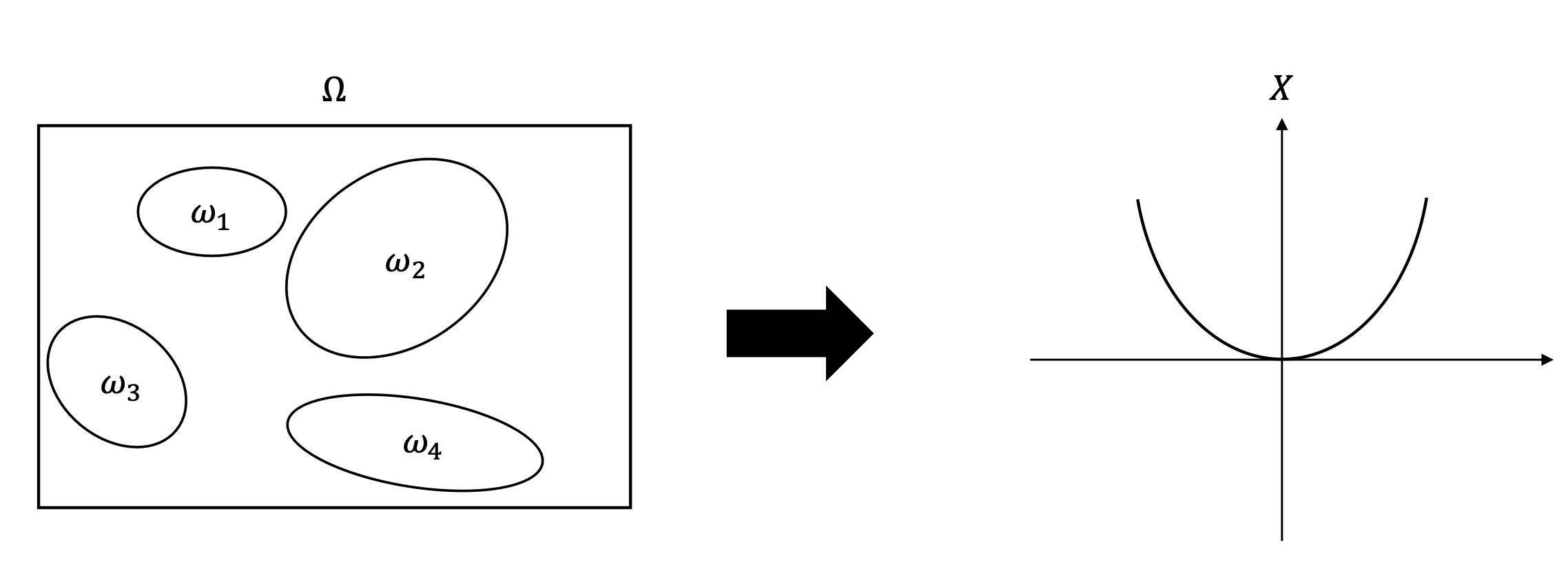
The collection of the probabilities
is the distribution function of .